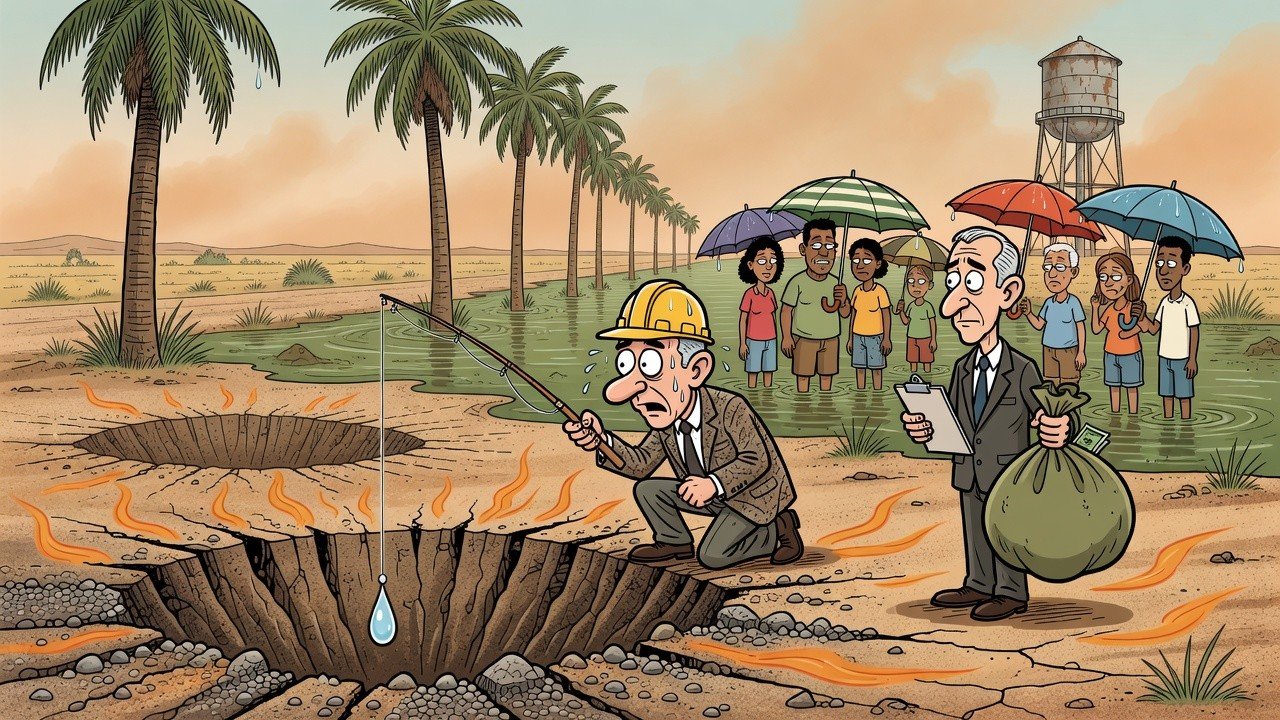
SATIRE: This is parody. Not a real news report.
ELSA — Flanked by a projector screen showing two rectangles labeled POND A and POND B, city officials announced Thursday that the Texas Water Development Board has committed $223,000 to answer one of the Rio Grande Valley’s oldest questions: can two existing gravel pits hold water? Several residents noted the pits have answered that question themselves, free of charge, every single time it has rained since they were dug.
“This is a pretty innovative project,” said City Manager Cuco Salinas, stressing the idea remains exploratory. “Right now these are just holes. The question is whether they can be holes with a purpose. The state is investing $223,000 to find out, and we expect a preliminary answer sometime after the next several floods.”
Study To Formally Establish That Holes Are Holes
The $223,000 is divided into three phases. Phase one will document that the gravel pits are concave. Phase two will confirm that rain, in this region, generally falls downward. Phase three — funded by whatever is left — will place water into the concave places and observe whether it stays.
“We can’t just call a hole a pond,” said Texas Water Development Board spokesperson Debora Llanes. “In Texas, a hole is a hole until a licensed engineer is paid to sign a document saying otherwise. That document costs $223,000.”
Audience members pointed out the pits already hold water during every storm, sometimes up to the axles of a Ford F-150. “That’s anecdotal water,” Salinas said. “Legally, it doesn’t count until it’s in a PDF.”
City Pre-Announces 20 Dry Years, Delivery Pending
Salinas then declared the ponds will alleviate flood stress “for the next 20 years,” a figure he described as firm even though the ponds are not. The two dry decades are scheduled to begin after the study confirms the holes hold water, followed by a design phase, a funding phase, and a short ceremony in which the city formally apologizes to the pits for decades of calling them eyesores.
The relief will extend to Edcouch and La Villa, because flooding, like a study, does not stop at the city limits. “This area is growing exponentially,” Salinas said. “Every new slab is another gallon of runoff, and Elsa intends to be ready with two holes — assuming the science comes back saying holes receive things.”
If the study concludes gravel pits cannot hold water, officials have a contingency: a second, larger study asking why not.
Q: Will this stop my street from flooding?
A: Eventually. First the state must confirm, in writing, that the holes currently holding water can hold water.
Q: When do the 20 dry years start?
A: They’ve already begun, spiritually. Officially they start after the study, the design, the funding, and one final check that the holes are still holes.