SATIRE: This is parody. Not a real news report.
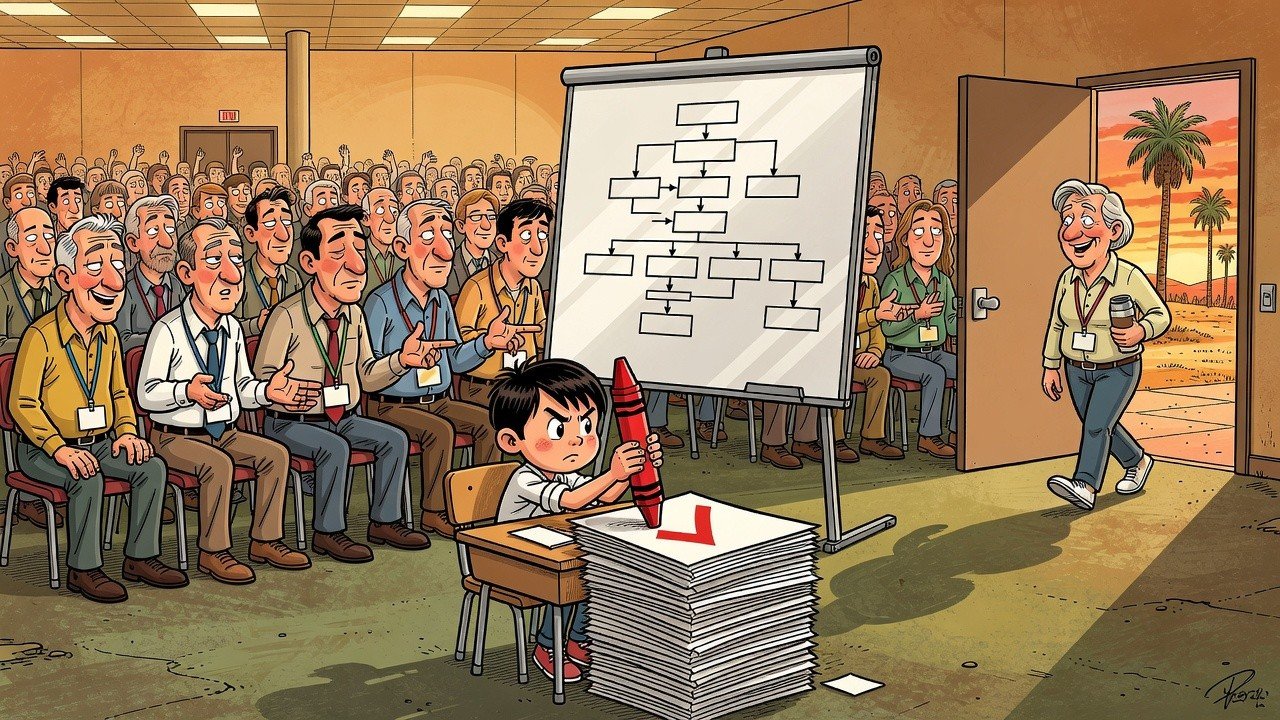
EDINBURG — More than 200 educators filed into the Region One Education Service Center’s annual iTech and AI Summit on Monday to finalize a 47-page governance framework for artificial intelligence in Valley classrooms, a document that will now be forwarded, like every other piece of AI work in the Rio Grande Valley, to a panel of third graders for grading.
The summit opened with a keynote titled, in the spirit of the event, “Guardrails Before Grading,” then proceeded through breakout sessions on data privacy, ethical prompting, and assistive technology. By 11 a.m., attendees had produced three acronyms, a laminated flowchart, and a shared understanding that no machine shall replace what a teacher does — a standard that will be verified the way all standards are verified locally: by an eight-year-old holding a red crayon and zero grudges.
“We spent the entire morning on governance,” said Dr. Delfina Cavazos, Region One’s newly created Deputy Coordinator of Guardrail Alignment, lifting the framework overhead like a lasagna pan. “Forty-seven pages. Cross-referenced. Laminated. And when it’s finished it goes straight to Room 12, because honestly the kids have a really good eye.”
Quality-Control Department Consists of Nine-Year-Olds and a Sticker Chart
The review process was modeled on the work of Marisol Peña, a third-grade teacher at Rayburn Elementary in McAllen, who asked an AI to generate vocabulary images and packets, got her evenings back, and routed the machine’s homework to the only auditors available at 3:15 p.m.: her students.
“The robot drew ‘archipelago’ as one island wearing sunglasses,” Peña said. “My class returned the packet with a note in crayon that said ‘this is a beach, try again.’ That is accountability. That is governance. Meanwhile I was home by five eating dinner like a person.”
Under the summit’s new rubric, all AI output can receive one of three scores: a check mark, two check marks, or a drawing of a truck, which attendees confirmed is the local equivalent of a federal audit.
‘Humans First, Robot Second’ Now Also Applies to Robots
Edinburg additionally ratified the Mission Protocol, adapted from Mission CISD parent Rico Barbosa’s household rule that his kids must attempt their homework themselves before consulting the machine. The district version extends the same dignity upward: the robot must attempt the packet before a third grader grades it, and the third grader must attempt mercy before drawing the truck.
“Everybody in this Valley attempts the work first,” Barbosa said. “That’s what makes us a community.”
The framework takes effect immediately, pending approval from the rotating third-grade panel, whose rulings are final at recess and revisable by snack time.
Frequently Asked Questions
Q: Who has final authority over classroom AI in the Rio Grande Valley?
A: A rotating panel of third graders. Tenure is granted after one full semester and the documented loss of at least two teeth.
Q: What, specifically, are the guardrails?
A: No attendee could define them, but all agreed they are the thing that prevents the vocabulary dog from having nine legs again.