SATIRE: This is parody. Not a real news report.
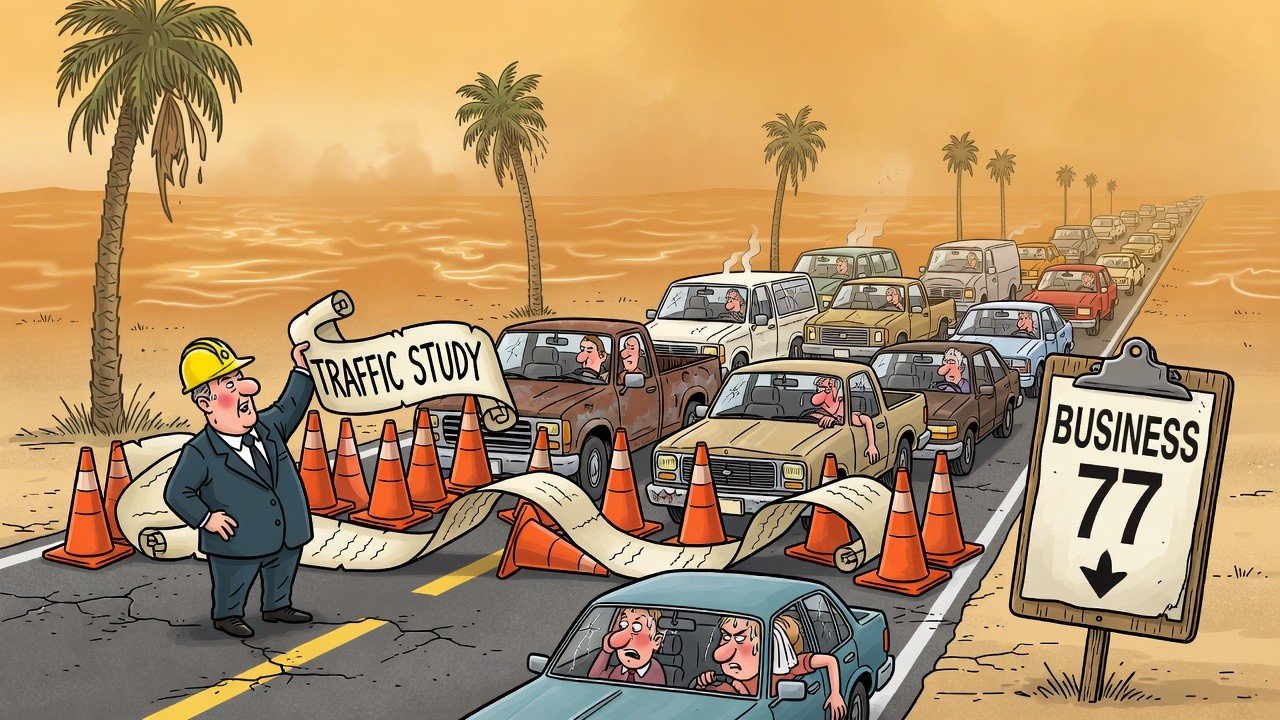
HARLINGEN — Flanked by easels, a laminated timeline stretching to 2031, and a folding table of complimentary maps nobody is allowed to keep, city officials unveiled Harlingen’s first-ever Mobility Master Plan Tuesday, a bold three-to-five-year initiative to address the city’s most dangerous corridors by commissioning additional studies of them.
The plan targets Harrison Avenue, Tyler Avenue, Ed Carey Drive, and Business 77 — roads locals know primarily for their frequent crashes and secondarily for the cones that appear after them. Rather than immediate construction, the city will gather public input, analyze safety data, and eventually recommend sidewalks, connections, and widening, at which point a feasibility study will determine whether the recommendations require further study.
Phase One: Studying Why Previous Studies Weren’t Studied Enough
“For decades, Harlingen drivers have asked, ‘When will something be done about Tyler Avenue?'” said interim mobility coordinator Dale Puckett, gesturing at a 40-slide PowerPoint titled Tyler Avenue: A Retrospective. “Today we can proudly answer: something is being done. It’s this. A study. Possibly several.”
Puckett confirmed the city has already formed a Steering Committee, a Technical Advisory Committee, and a third committee whose sole purpose is deciding where the first two committees will park along Business 77, a task expected to take eighteen months.
“We’re not just kicking the can down Ed Carey Drive,” Puckett insisted, noting that kicking cans down Ed Carey Drive is itself under review as a potential micro-mobility pilot. “We’re commissioning a comprehensive analysis of the can.”
Public input sessions begin next month, where residents will be invited to mark problem intersections on giant maps. Those maps will then be studied, the study of the maps will be studied, and by Phase Four the city hopes to produce a 600-page document whose cover features an artist’s rendering of a sidewalk.
Officials Stress Patience, Since Construction Would Interrupt The Studying
“If we actually built something right now, we’d have no baseline data,” explained consultant Marv Delgado of the firm Studied & Studied, LLC, which was hired following a competitive review process that lasted longer than most Harlingen marriages. “You can’t measure traffic improvement without years of untouched, worsening traffic. Honestly, the congestion is performing beautifully.”
City leaders estimate that by 2030, Harlingen will possess the most thoroughly documented left turn onto Harrison Avenue in the state of Texas, if not the nation.
At press time, officials had announced an exciting addendum: a $200,000 study to determine whether the original Mobility Master Plan will require a Mobility Master Plan.
Frequently Asked Questions
Q: Will any road actually get fixed?
A: Yes — the road to the public input sessions, which the city has resurfaced twice for accessibility.
Q: What if traffic gets worse during the study?
A: That’s not a failure, that’s data.