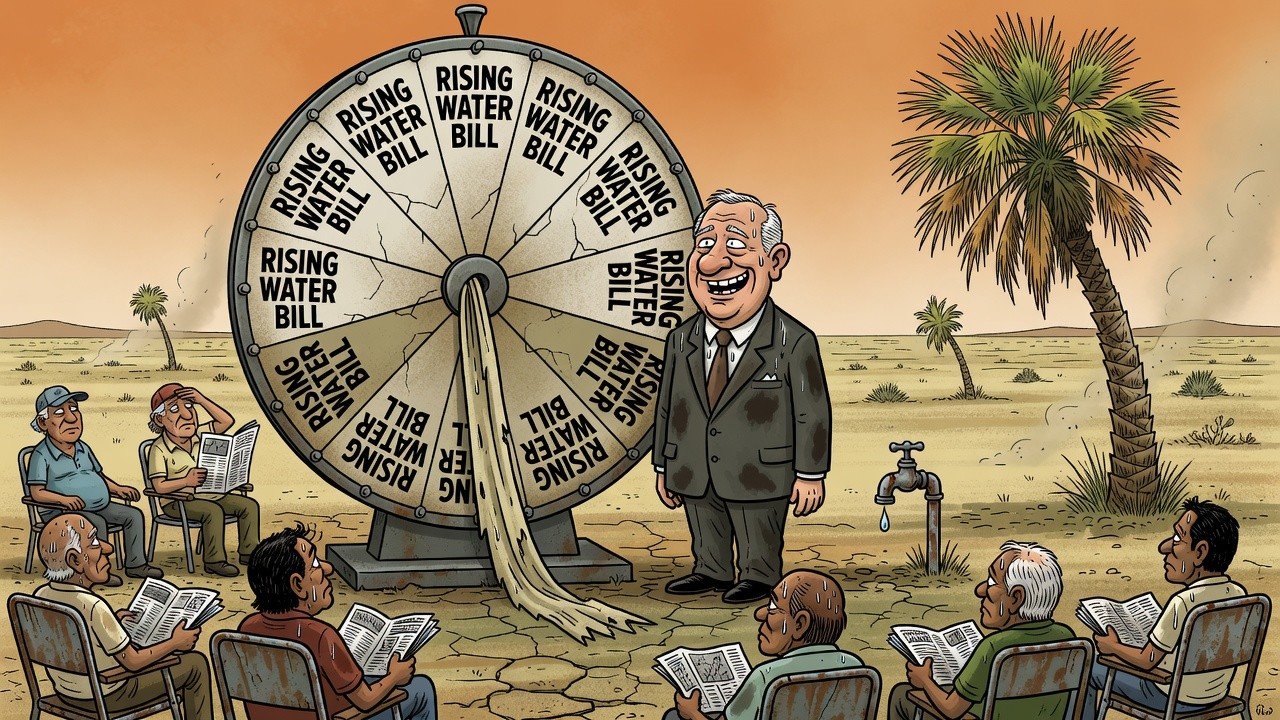
SATIRE: This is parody. Not a real news report.
MCALLEN — In what officials are calling a bold leap forward in municipal finance, the City of McAllen opened bidding this week on new brackish groundwater desalination wells, promising residents that no matter which contractor wins, they will lose exactly the same amount of money.
“This is a completely open and competitive process,” said Deputy Utilities Director Ramon Fuentes, gesturing proudly at a sealed bid box labeled “RATE HIKE GENERATOR, DO NOT SHAKE.” “Contractors submit their numbers, we review them carefully, and then — and this is the beautiful part — your water bill goes up. Whoever they are. Whatever they bid. That’s fairness.”
The city has raised water rates several times in recent years for infrastructure projects, and insiders say the desalination effort represents an exciting evolution: the first rate increase to be announced before the thing being paid for has a price.
“The Math Is Very Flexible”
City documents show the bids will be evaluated using a proprietary formula known internally as “The Escalator,” in which low bids trigger a rate increase because of cost-of-living adjustments, medium bids trigger a rate increase because of contingency planning, and high bids trigger a rate increase because, in Fuentes’s words, “yikes.”
“If a contractor bids zero dollars, that’s actually the most expensive scenario,” explained rate consultant Dana Whitlock of the firm Aguas Costosas LLC. “A free well means free brine discharge, which means free regulatory scrutiny, which means we pass that savings directly onto the resident as a fee. It’s circular. It’s elegant. It’s McAllen.”
At a packed public input session at the Palm View Community Center, residents were given participation worksheets with one question — “How would you like to be notified about the rate increase?” — with options including mail, email, and “surprise.”
Drought Cited As Reason Water Should Cost More
Officials stressed that diversifying the Valley’s water supply during ongoing drought is critical, which is precisely why residents should begin setting aside money now for a commodity that is falling from the sky less than ever.
“There’s less water. Therefore the water costs more. Therefore we drill for saltier water. Therefore we remove the salt. Therefore that costs more,” Fuentes said, drawing a circle on a whiteboard. “If you follow the circle long enough, you arrive at the rate hike every single time. Science.”
The city expects to announce the winning bid and the resulting rate increase simultaneously, possibly in the same sentence, pending confirmation that the sentence can hold that much.