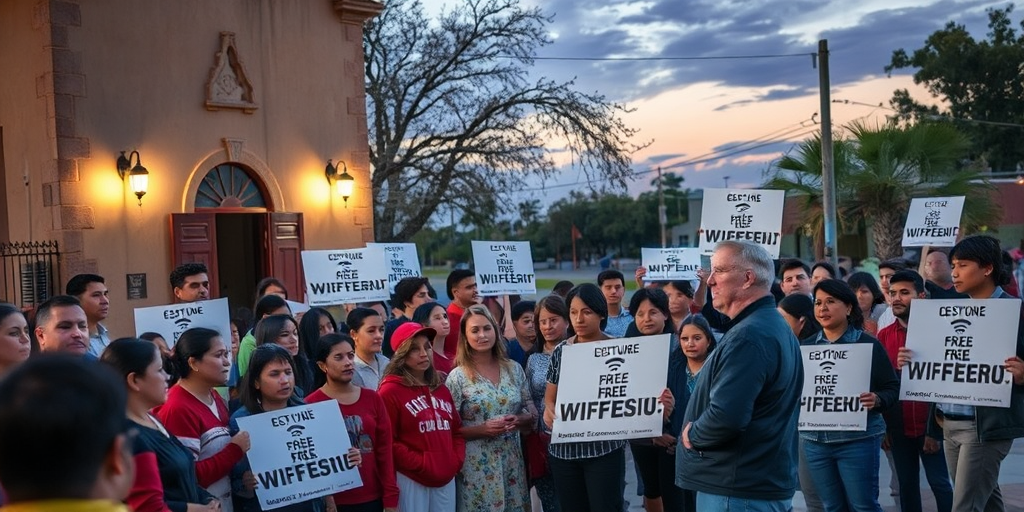
**LUPE Advocates for Restoration of Free Wi-Fi in Hidalgo County’s Rural Areas**
The Rio Grande Valley community is once again at a crossroads, as La Union del Pueblo Entero (LUPE) ramps up its advocacy efforts for the restoration of free Wi-Fi services in rural Hidalgo County. With the county’s decision to terminate this essential service by the end of 2025, tension stands ready to build over access to digital resources—a necessity many Valley residents rely on beyond mere convenience.
**Background on the Digital Divide**
The decision to end free Wi-Fi affects approximately 130 rural colonias in Hidalgo County, a consequence of depleted COVID-era funding that fueled the initiative. “Even though COVID is over, the internet continues being part of our lives,” expressed Maria Arias, a committed resident of rural Edinburg, highlighting how internet access has evolved from a luxury to a basic necessity.
Implemented in 2021, the free Wi-Fi service was a lifeline during the pandemic, facilitating remote education and work. However, Hidalgo County Judge Richard Cortez insists that reallocating taxpayer money for this purpose requires new legislative backing. “The pandemic has now ended, the funding that once was available is also ended,” Cortez declared, citing the end of specific fiscal avenues that initially supported the program.
**Voices from the Community and LUPE’s Stand**
LUPE Executive Director Tania Chavez has underscored the importance of developing a long-term action plan, expressing dissatisfaction with the current lack of foresight. “We had four years to put together a plan of action,” Chavez lamented, urging the county for a feasibility study to map out and address connectivity gaps plaguing the rural communities.
Chavez’s calls are not in isolation. Maria Arias, who once relied on the free internet to keep her children abreast with their schooling, echoed the sentiment at a recent Hidalgo County Commissioners Court meeting. “Many folks in the rural communities can’t even contact the provider because the optic fiber doesn’t reach them,” Chavez added, emphasizing the infrastructural shortcomings that still persist.
**Limited Options for Residents**
County officials maintain that residents can access internet services at community resource centers or public libraries in Hidalgo County, yet this reality falls short for many in the remote expanses of South Texas. Without broader service coverage or substantial governmental intervention, these interim solutions offer limited solace.
Commissioner Eduardo “Eddie” Cantu acknowledged the significance of internet access but cited statutory limitations. “Unfortunately… we don’t have the authority to provide internet services,” Cantu conveyed, linking future service restoration to a community-driven push for revised policy frameworks or external funding.
**Significance for the Rio Grande Valley**
The implications are multifaceted for Valley residents. The internet isn’t just a means for social media or streaming; it enables educational pursuits, access to healthcare services, and even civic participation, creating a digital inclusivity that is indispensable today. “My children constantly worry about whether they can afford to live near us once they start their families,” expressed Maria Diaz, underscoring broader socioeconomic strains.
The cessation of the Wi-Fi service also hints at a recurring issue in the region: infrastructure projects delayed or derailed due to funding limitations, much like the yet-to-begin $6.2 million parking garage for the new Hidalgo County Courthouse, expected to kick off in September 2025.
**Looking Forward: Bridging the Digital Divide**
As municipalities across the nation wrestle with bridging their digital divides, Hidalgo County’s scenario reflects broader challenges faced by economically diverse areas. The discussion here could potentially inspire policy innovations and funding solutions extending beyond the county line—a beacon of proactive change suited for contemporary demands.
Yet, as the stakeholders push for restoration and improvement of services, consideration remains on executing sustainable, budget-conscious strategies. Dr. Teresa Galvan, an economist at the University of Texas Rio Grande Valley, cautions against hasty measures devoid of robust fiscal alignment. “While tax incentives can stimulate growth, it’s crucial that they are implemented with foresight to avoid budgetary shortfalls,” Galvan posits, framing a necessary balance between aspiration and accountability.
**Resources and Community Engagement**
Amidst the advocacy, LUPE invites residents to partake in ongoing dialogues and workshops designed to explore digital connectivity alternatives. Additionally, Hidalgo County’s public affairs office is available for inquiries, cementing lines of communication as solutions unfurl.
Despite limited current avenues, the quest for restored internet access shares a unified underlying goal—uplifting the lives of everyday South Texans through technological empowerment, ultimately forging a more resilient community where technological divides no longer exist.
In focusing on digital access, homespun stories of struggle and perseverance amplify a call-to-action that reaches far within and beyond Hidalgo County borders, testifying to the Valley’s enduring spirit of innovation and community togetherness.