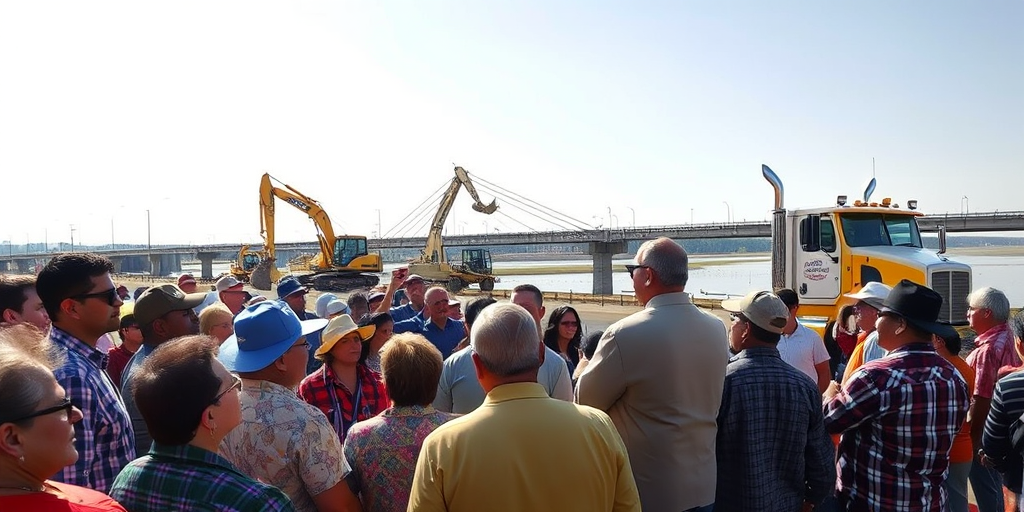
Pharr Bridge Expansion: A Vision for Seamless Crossings
In an ambitious leap toward improving trade efficiency and local economy, the Pharr International Bridge will see a significant expansion with a second span aimed at eliminating truck wait times completely. Directed by Luis Bazan, the bridge’s expansion project is set to be completed by early 2026 at an estimated cost of $44 million.
Eliminating Wait Times: A Bold Prediction
Luis Bazan, the director of the Pharr International Bridge, has confidently forecasted that the new span will eradicate the wait times for trucks. “When the expansion is completed, the whole purpose is not just to cut back, but to eliminate wait times,” said Bazan during his keynote at the Pharr Economic Development Corporation’s 2025 Industrial Warehouse Summit. By doubling its capacity with four additional lanes, the bridge will cater to a smoother, more efficient movement of certified conveyances, with the aim of achieving crossing times of merely ten to fifteen minutes.
Strategic Partnerships and Planning
The expansion project is the result of a strategic collaboration between the Pharr International Bridge and federal agencies, including Customs and Border Protection. This cooperation has focused on refining the efficiency from entry to exit points on the bridge. “We’re building a bridge to cross that bridge to make us more efficient,” Bazan emphasized, stressing the importance of this expansion for trade efficiency in the Rio Grande Valley (RGV).
The enhanced infrastructure will include two fast lanes and secure trade lanes, improving not just speed, but also the safety of certified vehicles traveling from Mexico to the United States.
Impact on the Rio Grande Valley
For the South Texas region and Valley residents, this expansion holds considerable promise. Not only is it expected to expedite logistics and trade, thereby bolstering local economic activities, but it also positions the Rio Grande Valley as a pivotal trade hub. According to local economist Dr. Maria Gonzalez of the University of Texas Rio Grande Valley, the bridge “serves as a vital artery for the transportation of goods. Its enhancement could have far-reaching economic benefits for the community,” she explains.
Encouraging companies to become certified for SENTRI and fast lanes aligns with the strategy to ensure a seamless transition and no delays, thus fostering a more robust business climate. “This project,” Martinez says, “will attract more businesses to settle in the Valley, reinforcing our economic landscape.”
Connecting with Past Efforts and Ongoing Challenges
The RGV has historically faced challenges related to infrastructure development and border congestion. These issues have been focal points in local infrastructure debates. With previous initiatives seeking to tackle these problems, the bridge expansion represents a significant stride toward long-term resolutions.
Community member and Hidalgo County resident, Rosa Martinez, shares her enthusiasm. “We’ve seen progress over the years, and this bridge project is exactly what we need to further reduce congestion and support our local economy,” she states.
Future Prospects and Considerations
Looking forward, the bridge’s increased capacity will set a new precedent for infrastructure development in border areas. However, public officials emphasize the importance of maintaining the momentum. “It’s about building on this breakthrough while ensuring policies support sustainable growth,” says Matthew Smith, a local government policy analyst.
Balanced coverage is paramount, with some stakeholders still expressing concerns regarding broader infrastructure funding. Local government must ensure that the economic growth stimulated by the bridge doesn’t overshadow the need for comprehensive infrastructure strategy in other areas, like public transportation and housing developments.
Local Resources and Community Engagement
Valley residents seeking more information on the bridge expansion can turn to resources provided by local authorities. Public forums and informational sessions will be held to engage the community, offering a platform for inquiries and feedback. The Pharr International Bridge office encourages stakeholders to participate, emphasizing transparency and cooperation.
In conclusion, the Pharr Bridge expansion project is a beacon of progress for the RGV, promising to enhance logistics and invigorate trade currents that fuel the local economy. While challenges remain, this venture marks a significant investment in the Valley’s future, underlining its strategic importance along the US-Mexico border. With community support and thoughtful implementation, it has the potential to transform regional commerce and benefit the broader South Texas community.