‘No Kings’ Protest Garners Attention Across the Rio Grande Valley
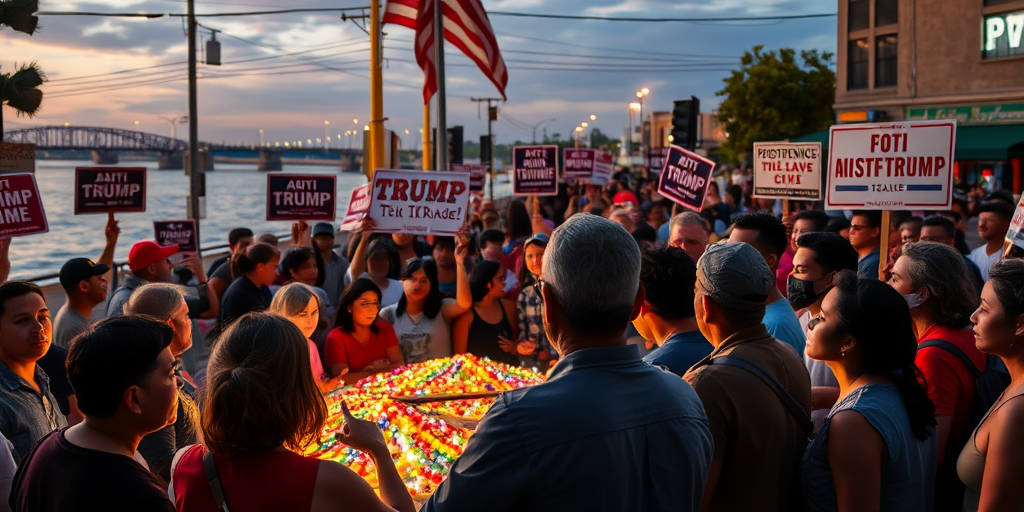
A series of “No Kings” protests took place across the Rio Grande Valley on Saturday, reflecting a nationwide demonstration against policies associated with former President Donald Trump. The protests saw around 300 participants gather in McAllen and an additional 200 in Harlingen, contributing to the larger national movement aimed at critiquing what participants describe as authoritarian policies.
Protest Dynamics and Local Participation
The protests brought together a diverse array of participants, each voicing their concerns over specific political decisions and the overarching influence they believe Trump has had on American democratic ideals. Jennifer Hewitt, a local veteran attending the protest, emphasized her motivation by stating, “We do all this stuff to defend our country, because we love our country, and right now, I just don’t recognize it. It’s just wrong.”
Such sentiments have resonated across the Valley, indicating a significant portion of the community’s desire for political change and adherence to more democratic principles. The “No Kings” protests, while peaceful, reflect deep-seated concerns over past and potential future executive actions perceived as undermining American values.
Background: Nationwide Movement
The “No Kings” protests emerge against a backdrop of political tension nationwide, as former President Trump rekindled criticism for both his previous administration’s actions and his ongoing political influence. This round of protests follows a public statement he made against Colombian President Gustavo Petro, suggesting controversial foreign policy measures that further fueled public discontent.
Moreover, Trump’s rhetoric and policies have not only polarized international relations but have also stirred domestic divisions, leading to public demonstrations advocating for accountability and reform.
Local News: Broader Implications for the RGV
For the Rio Grande Valley, engaging in such protests signifies a willingness to participate in national discourse, contributing Valley residents’ voices to broader debates affecting local policies and governance. These protests underscore the region’s active role in shaping national narratives and realize South Texas’s potential impact on progressive change.
Local response to the protests showcases a cross-section of opinions. While some Republican lawmakers dismissed the demonstrations as unpatriotic and misguided, organizers insist their movement stands on principles of democracy and accountability. House Speaker Mike Johnson, for instance, labeled the protests as representative of “wild leftist policy priorities,” reflecting the spectrum of attitudes toward these demonstrations.
Economic and Community Concerns
Despite being primarily political, the protests hint at underlying economic and societal issues within the RGV that have long been topics of concern. Notably, the need for policy reform touches sectors like housing, education, and community services, which continue to engage local policymakers and advocates in dialogues aimed at advancing the quality of life in the Valley.
Among recent headlines in the region, discussions around a local vehicle crash in McAllen, suspected to be alcohol-related, raise questions about community safety and resource allocation. Likewise, UTRGV endeavors to address healthcare shortages by expanding podiatric medicine education, linking initiatives that contribute toward vibrant, sustainable communities.
Future Possibilities and Perspectives
Looking forward, the Valley’s active engagement in nationwide movements like “No Kings” elucidates a trajectory towards more robust civic participation. As residents increasingly wield their voices in such forums, it prompts broader societal reflection on governance models and policy implementation.
In a climate of evolving political consciousness, the Rio Grande Valley remains positioned to shape legislative discourse that aligns with constituent interests. Continued emphasis on dialogue and consensus building becomes imperative for fostering harmonious inter-community relations and ensuring equitable policy practices.
Resources and Public Engagement
For those interested in participating or learning more about ongoing political movements and local dialogues, community members can engage with local organizations and attend future protests or discussion panels. The RGV’s role as a vibrant center of political, social, and economic activity reflects its community’s dedication to transformative progress.
Through platforms like KRGV News and public forums, residents have a plethora of resources to stay informed and involved in shaping the Valley’s collective future. It underscores the essential role of community interest and activism in driving meaningful social change.
The recent series of protests marks both a challenge and an opportunity for the RGV, one that invites active participation and continuous dialogue—key ingredients in fostering a resilient, inclusive community aligned towards visionary goals.